
While beginners often treat tuples merely as “read-only lists,” seasoned Python engineers understand that tuples serve a fundamentally distinct role: data records. Where a list represents a homogeneous sequence of items, a tuple encapsulates heterogeneous attributes whose semantics depend strictly on their positional indices.
In this comprehensive article, based on Part 1 Section 08 of Fred Baptiste’s Python Series, we dissect tuple memory architecture in CPython, master pattern unpacking, and elevate structured records using collections.namedtuple and typing.NamedTuple.
1. Tuples as Data Records vs. Lists
In Python’s conceptual model:
- Lists are ordered collections of homogeneous data (
[1, 2, 3],['apple', 'banana', 'cherry']). Adding or removing elements does not change the core meaning of the collection. - Tuples are structured records where position imparts meaning (
('London', 51.5074, -0.1278)). The 0th index is the city name, index 1 is latitude, and index 2 is longitude.
# A list of stock prices over time (homogeneous sequence)
daily_prices = [182.4, 184.1, 183.9, 186.2]

# A tuple representing a single stock transaction record (heterogeneous data record)
# Schema: (symbol, timestamp, price, volume, broker_id)
trade_record = ("AAPL", "2025-12-26T09:30:00Z", 185.50, 1000, "BRK_42")

print(f"Ticker: {trade_record[0]}, Volume: {trade_record[3]}")
The Inherent Immutability Trade-Off
A tuple’s memory layout is fixed at creation time. Because tuples cannot resize, CPython allocates exactly the required memory block with zero spare capacity overhead.
import sys

empty_list = []
empty_tuple = ()

print(f"Empty list size : {sys.getsizeof(empty_list)} bytes")   # ~56 bytes
print(f"Empty tuple size: {sys.getsizeof(empty_tuple)} bytes")  # ~40 bytes

five_list = [1, 2, 3, 4, 5]
five_tuple = (1, 2, 3, 4, 5)

print(f"5-item list size : {sys.getsizeof(five_list)} bytes")   # ~120 bytes (allocates overallocation buffer)
print(f"5-item tuple size: {sys.getsizeof(five_tuple)} bytes")  # ~80 bytes (exact fit)
Furthermore, CPython employs freelists and singleton optimizations for small tuples: an empty tuple () is a cached singleton, and deallocated tuples up to 20 elements are kept in reuse pools to minimize heap churn during rapid allocations.
2. Shallow Immutability and Hashability
A critical distinction in Python’s data model is that tuple immutability is shallow.
A tuple holds fixed pointers (memory addresses) to other Python objects. Those pointers cannot be redirected or removed. However, if an address points to a mutable object, that object itself can mutate in place!
# Tuple containing an integer (immutable) and a list (mutable)
record = (100, [1, 2, 3])

try:
    record[0] = 200
except TypeError as e:
    print("Cannot change pointer:", e)

# But mutating the referenced list succeeds!
record[1].append(4)
print("Mutated record:", record)  # (100, [1, 2, 3, 4])
Hashability Rules
An object is hashable if its hash value never changes during its lifetime and it can be compared to other objects.
- A tuple is hashable if and only if all of its elements are themselves hashable.
- If a tuple contains a list, set, or dict,
hash(my_tuple)raisesTypeError: unhashable type: 'list'. - Only hashable tuples can serve as keys in dictionaries or elements in sets.
3. Idiomatic Unpacking and the Extended Star Syntax
Because tuple positions encode semantic fields, unpacking is the standard way to consume tuple data cleanly without relying on brittle raw index numbers:
# Unpacking geographic coordinate record
city, lat, lon = ("San Francisco", 37.7749, -122.4194)
print(f"{city} coordinates: ({lat}, {lon})")
Extended Unpacking with *
Python allows the asterisk * operator on the left-hand side of an assignment to capture any remainder of elements into a standard list:
record = ("John Doe", 32, "Engineer", "Python", "Go", "Rust", "Kubernetes")

name, age, title, *skills = record
print(f"{name} ({age}) - Skills: {skills}")
# Output: John Doe (32) - Skills: ['Python', 'Go', 'Rust', 'Kubernetes']

# Unpacking at the start or middle
first, *middle, last = [10, 20, 30, 40, 50, 60]
print(f"First: {first}, Middle: {middle}, Last: {last}")
# First: 10, Middle: [20, 30, 40, 50], Last: 60
Discarding Values with _
By convention, use the underscore identifier _ to signify ignored fields:
# We only care about the ticker and closing price
ticker, _, _, close_price, _ = ("MSFT", "2025-12-26", 420.0, 425.2, 5000000)
print(f"{ticker} closed at ${close_price}")
4. collections.namedtuple: Self-Documenting Records
Relying purely on numeric indices (record[0], record[1]) quickly degrades maintainability in large codebases. What was index 4 again?
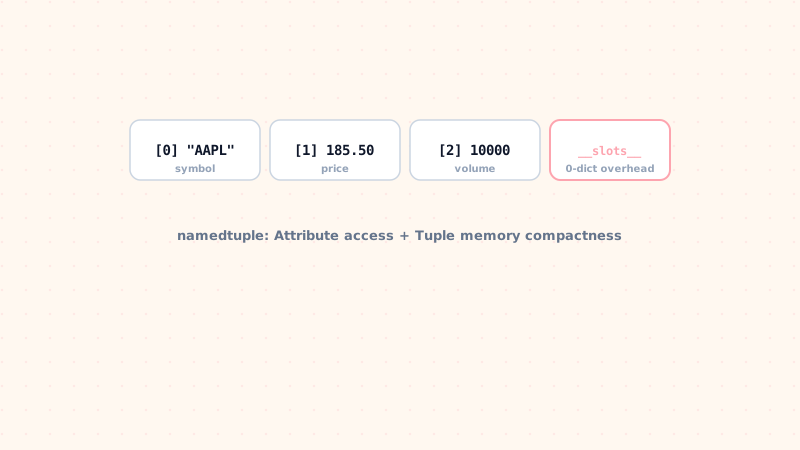
The collections.namedtuple factory solves this by synthesizing a customized tuple subclass that allows attribute-style access (record.price) while maintaining 100% backward compatibility with tuples (unpacking, immutability, index access, zero dictionary overhead).
from collections import namedtuple

# Define the Point schema
Point2D = namedtuple("Point2D", ["x", "y"])

p1 = Point2D(10, 20)
p2 = Point2D(x=30, y=40)

# Attribute access
print(f"p1 x={p1.x}, y={p1.y}")

# Standard tuple operations remain intact
print(f"p1[0] = {p1[0]}")
x_coord, y_coord = p1
print(f"Unpacked: {x_coord}, {y_coord}")
print(f"Is instance of tuple? {isinstance(p1, tuple)}")  # True
Field Name Specifications
The namedtuple factory accepts field names in several flexible formats:
# As a list of strings
User = namedtuple("User", ["id", "username", "email"])

# As a comma-separated string
User = namedtuple("User", "id, username, email")

# As a whitespace-separated string
User = namedtuple("User", "id username email")
If your data source contains invalid Python identifiers (like numbers or reserved keywords), pass rename=True to auto-rename offending fields to positional placeholders:
Record = namedtuple("Record", "def, class, 123, valid_field", rename=True)
print(Record._fields)  # ('_0', '_1', '_2', 'valid_field')
5. Built-in Introspection and Utility Methods
All namedtuple subclasses provide specialized utility methods prefixed with an underscore _ (to prevent collision with your field names):
1. _asdict(): Serialization
Converts the namedtuple into a standard Python dictionary:
p = Point2D(15, 25)
print(p._asdict())  # {'x': 15, 'y': 25}
2. _replace(**kwargs): Functional Updates
Because namedtuples are immutable, you cannot alter fields in place. _replace constructs a new instance with specified fields modified:
Stock = namedtuple("Stock", "symbol price volume")
s1 = Stock("GOOGL", 175.0, 100)

# Create an updated copy with a new price
s2 = s1._replace(price=178.5)

print("Original:", s1)  # Stock(symbol='GOOGL', price=175.0, volume=100)
print("Updated :", s2)  # Stock(symbol='GOOGL', price=178.5, volume=100)
3. _fields and _field_defaults
Allows programmatic inspection and dynamic extension:
print(Stock._fields)  # ('symbol', 'price', 'volume')

# Define default values for rightmost fields (or all fields in Python 3.7+)
ServerConfig = namedtuple(
    "ServerConfig",
    "host port timeout max_retries",
    defaults=[8080, 30.0, 3]  # port, timeout, max_retries get defaults
)

cfg = ServerConfig(host="localhost")
print(cfg)  # ServerConfig(host='localhost', port=8080, timeout=30.0, max_retries=3)
6. Extending Namedtuples with Methods & Properties
Because a namedtuple creates a regular Python class, you can subclass it to attach domain methods, properties, and custom docstrings:
import math
from collections import namedtuple

BaseVector = namedtuple("Vector2D", "x y")

class Vector2D(BaseVector):
    """2D Mathematical Vector with Euclidean distance calculation."""

    __slots__ = ()  # CRUCIAL: prevents creation of an instance __dict__, keeping memory tiny!

    @property
    def magnitude(self) -> float:
        return math.hypot(self.x, self.y)

    def dot(self, other: "Vector2D") -> float:
        return self.x * other.x + self.y * other.y

    def __repr__(self) -> str:
        return f"Vector2D(x={self.x:.2f}, y={self.y:.2f}, mag={self.magnitude:.2f})"

v1 = Vector2D(3, 4)
v2 = Vector2D(1, 2)

print(v1.magnitude)  # 5.0
print(v1.dot(v2))    # 11
print(v1)            # Vector2D(x=3.00, y=4.00, mag=5.00)
[!IMPORTANT] When subclassing a namedtuple, always declare
__slots__ = (). If omitted, Python will allocate a dynamic__dict__for each instance, obliterating the memory efficiency that made namedtuples appealing in the first place!
7. typing.NamedTuple: Modern Declarative Syntax
In Python 3.6+, the typing module introduced NamedTuple, which supports declarative class definitions with native type hints:
from typing import NamedTuple
from datetime import datetime

class AuditLog(NamedTuple):
    event_id: str
    user_id: int
    action: str
    timestamp: datetime = datetime.utcnow()
    success: bool = True

log = AuditLog(event_id="evt_901", user_id=42, action="LOGIN")
print(log)
print(f"Type annotations: {AuditLog.__annotations__}")
Architectural Comparison: Which Record Type to Use?
| Feature | Regular tuple | collections.namedtuple | typing.NamedTuple | @dataclass(frozen=True) |
|---|---|---|---|---|
| Named Fields | ❌ (Index only) | ✅ Yes | ✅ Yes | ✅ Yes |
| Type Annotations | ❌ None | ❌ Awkward | ✅ Native & Clean | ✅ Native & Clean |
| Immutability | ✅ Yes | ✅ Yes | ✅ Yes | ✅ Yes (frozen=True) |
| Unpacking Support | ✅ a, b = t | ✅ a, b = t | ✅ a, b = t | ❌ Requires custom __iter__ |
| Memory Footprint | ⚡ Smallest | ⚡ Smallest | ⚡ Smallest | 🔹 Slightly higher (slots helps) |
| Inheritance Support | ❌ Hard | ⚠️ Subclassing | ⚠️ Base class rules | ✅ First-class OOP |
Summary Decision Guide
- Use standard tuples for transient coordinate pairs, multiple return values, or database cursor records.
- Use
typing.NamedTuplewhen building immutable lightweight data packets that need positional unpacking and static type safety. - Use
@dataclass(frozen=True, slots=True)when you require rich OOP hierarchies, complex post-initialization hooks (__post_init__), or mutable states.