
Decorators are one of Python’s most elegant features, enabling clean separation of concerns and metaprogramming. Yet beneath the @decorator syntax lies a sophisticated mechanism of lexical scopes and heap-allocated closure cells.
In this comprehensive article, following Part 1 Section 07 of Fred Baptiste’s Python Series, we dissect Python’s scope resolution rules, discover how closures retain memory, and build production-grade parameterized decorators.
1. Scope Resolution: The LEGB Rule
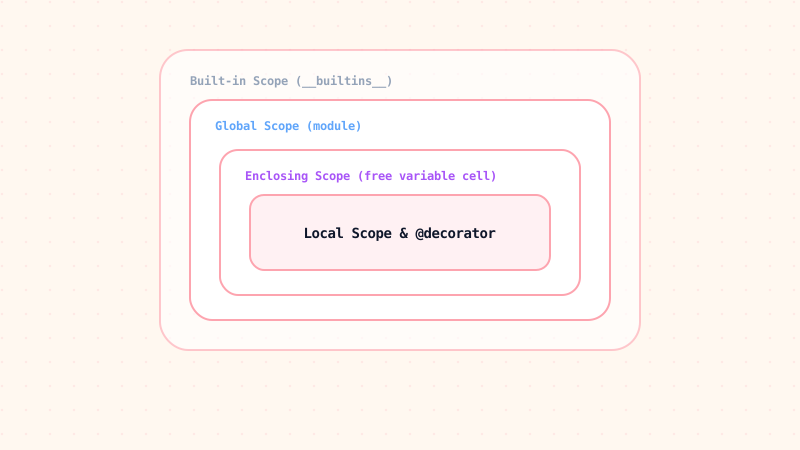
When Python encounters a variable name, it searches namespaces in a strict precedence order known as the LEGB Rule:
- L (Local): Identifiers defined within the current function execution frame.
- E (Enclosing): Identifiers in any enclosing function scopes (from innermost to outermost).
- G (Global): Identifiers defined at the module top-level or declared with
global. - B (Built-in): Pre-assigned built-in names (
len,range,ValueError).
x = "global"

def outer():
    x = "enclosing"
    def inner():
        x = "local"
        print("Inner sees:", x)
    inner()
    print("Outer sees:", x)

outer()
print("Module sees:", x)
Output:
Inner sees: local
Outer sees: enclosing
Module sees: global
The global and nonlocal Keywords
In Python, assignment (=) always defaults to creating or modifying a variable in the current local scope. To rebind a variable in an outer namespace, you must explicitly declare it:
def counter():
    count = 0
    def increment():
        nonlocal count  # Binds to count in the enclosing scope!
        count += 1
        return count
    return increment

inc = counter()
print(inc())  # 1
print(inc())  # 2
Without nonlocal count, Python would treat count += 1 as count = count + 1, detect an assignment to a local variable count before initialization, and raise an UnboundLocalError.
2. Anatomy of a Closure: How Free Variables Survive
What happens when an outer function returns an inner function? Normally, when a function completes execution, its stack frame is discarded and its local variables are eligible for garbage collection.
Consider this:
def make_multiplier(factor):
    def multiply(number):
        return number * factor
    return multiply

double = make_multiplier(2)
# make_multiplier has finished executing and exited!
print(double(10))  # 20
How does double still know that factor is 2?
The CPython Solution: Cell Objects
When the Python compiler parses make_multiplier, it notes that factor is referenced by the nested function multiply. Because factor is referenced from an enclosing scope without being defined locally, it is called a free variable.
Instead of storing factor on the transient call stack, CPython allocates a cell object on the heap:
print("Closure attribute:", double.__closure__)
# Closure attribute: (<cell at 0x103a8a970: int object at 0x102cb4110>,)

# Inspect the value inside the cell
print("Cell contents:", double.__closure__[0].cell_contents)  # 2
Both make_multiplier and multiply hold a reference to this identical cell object. When make_multiplier returns, the cell remains alive in memory because double.__closure__ holds an active reference count to it!
A closure is simply a function paired with an extended scope that holds references to free variable cells.
3. Decorators from First Principles
A decorator is simply a callable that takes a function as an argument and returns a closure:
def my_decorator(fn):
    def wrapper(*args, **kwargs):
        print(f"--> Calling {fn.__name__}")
        result = fn(*args, **kwargs)
        print(f"<-- Finished {fn.__name__}")
        return result
    return wrapper

def greet(name):
    return f"Hello, {name}!"

# Manual decoration
decorated_greet = my_decorator(greet)
print(decorated_greet("Alice"))
The @ symbol is syntactic sugar for this exact reassignment:
@my_decorator
def greet(name):
    return f"Hello, {name}!"

# Exactly identical to: greet = my_decorator(greet)
4. The Critical Problem of Lost Metadata: functools.wraps
When a function is wrapped by a decorator, its identity is silently replaced by the inner wrapper function:
@my_decorator
def calculate(a, b):
    """Perform mathematical calculation."""
    return a + b

print(calculate.__name__)  # 'wrapper'  <-- LOST ORIGINAL NAME!
print(calculate.__doc__)   # None       <-- LOST DOCSTRING!
This breaks IDE auto-completion, docstring documentation generators, and debugging stack traces.
The Remedy: @functools.wraps
functools.wraps is a built-in decorator that copies __name__, __doc__, __annotations__, and __module__ from the original function onto the wrapper:
from functools import wraps

def my_decorator(fn):
    @wraps(fn)  # Preserves fn's identity!
    def wrapper(*args, **kwargs):
        return fn(*args, **kwargs)
    return wrapper

@my_decorator
def calculate(a, b):
    """Perform mathematical calculation."""
    return a + b

print(calculate.__name__)  # 'calculate'
print(calculate.__doc__)   # 'Perform mathematical calculation.'
5. Decorator Factories: Passing Arguments to Decorators
What if we want our decorator to accept configuration parameters, such as @timed(num_reps=5)?
A decorator only accepts one argument: the target function fn. To pass parameters to a decorator, we must build a decorator factory—a function that accepts configuration arguments and returns the actual decorator:
import time
from functools import wraps

def timed(num_reps=1):
    """Decorator factory that benchmarks execution across N repetitions."""
    def decorator(fn):
        @wraps(fn)
        def wrapper(*args, **kwargs):
            total_time = 0.0
            last_result = None
            for _ in range(num_reps):
                start = time.perf_counter()
                last_result = fn(*args, **kwargs)
                total_time += time.perf_counter() - start
            avg_time = total_time / num_reps
            print(f"[{fn.__name__}] Avg time over {num_reps} reps: {avg_time:.6f}s")
            return last_result
        return wrapper
    return decorator

@timed(num_reps=3)
def compute_squares(n):
    return [i**2 for i in range(n)]

compute_squares(1_000_000)
Execution flow:
timed(num_reps=3)executes, returningdecorator.- Python evaluates
@decorator, callingdecorator(compute_squares). decoratorreturnswrapper, bindingcompute_squares = wrapper.
6. Real-World Architectural Decorators
1. In-Memory Memoization (Caching)
Caching the results of expensive, deterministic function calls:
from functools import wraps

def memoize(fn):
    cache = {}
    @wraps(fn)
    def wrapper(*args):
        if args not in cache:
            cache[args] = fn(*args)
        return cache[args]
    wrapper.cache = cache  # Expose cache for inspection
    return wrapper

@memoize
def fibonacci(n):
    if n < 2:
        return n
    return fibonacci(n - 1) + fibonacci(n - 2)

print("Fib(35):", fibonacci(35))
print("Cache entries count:", len(fibonacci.cache))
Note: For production code, always use the standard library’s C-accelerated functools.lru_cache(maxsize=128).
2. Execution Retry Decorator with Exponential Backoff
import time
import random
from functools import wraps

def retry(max_attempts=3, delay_sec=1.0, backoff=2.0):
    def decorator(fn):
        @wraps(fn)
        def wrapper(*args, **kwargs):
            attempts = 0
            current_delay = delay_sec
            while attempts < max_attempts:
                try:
                    return fn(*args, **kwargs)
                except Exception as err:
                    attempts += 1
                    if attempts == max_attempts:
                        raise err
                    print(f"Error: {err}. Retrying in {current_delay:.2f}s...")
                    time.sleep(current_delay)
                    current_delay *= backoff
        return wrapper
    return decorator

@retry(max_attempts=3, delay_sec=0.1)
def unreliable_network_fetch():
    if random.random() < 0.7:
        raise ConnectionError("Network timeout")
    return "Data payload received"
Key Takeaways
- LEGB Order: Python resolves names strictly via Local -> Enclosing -> Global -> Built-in.
- Cell Objects: Closures retain references to outer scope variables via persistent heap-allocated
cellobjects (__closure__). - Decorator Definition: A decorator wraps a callable in a closure to modify behavior non-invasively.
- Always Use
@wraps: Never write a decorator wrapper without@functools.wraps(fn)to preserve function identity. - Factories for Configuration: To pass arguments to a decorator (
@my_dec(arg=1)), wrap it in a factory that returns the decorator.