
In Python, functions are first-class citizens. This means a function is not merely a syntactic block of code; it is a full-fledged object—an instance of the function class living on the heap.
In this guide, following Part 1 Section 06 of Fred Baptiste’s Python Series, we investigate callables, function introspection, higher-order functional patterns, and C-accelerated functional utilities.
1. What Makes an Object “Callable”?
Any object that can be invoked using the parentheses operator () is a callable. In Python, callability can be tested with the built-in callable() function:
def my_func():
    return 42

class Multiplier:
    def __init__(self, factor):
        self.factor = factor
    def __call__(self, val):  # Makes instances callable!
        return val * self.factor

mult_10 = Multiplier(10)

print(callable(my_func))   # True
print(callable(mult_10))   # True
print(mult_10(5))          # 50
print(callable("text"))    # False
There are several types of callables in Python:
- Built-in functions (e.g.,
print,len) - Built-in methods (e.g.,
str.upper,list.append) - User-defined functions (created with
deforlambda) - Methods (functions bound to class instances)
- Classes (calling a class invokes
__new__and__init__to instantiate an object) - Class instances implementing the
__call__dunder method - Generators & Coroutines
2. Function Introspection and Attributes
Because functions are real objects, they have attributes:
def calculate_growth(initial_value: float, rate: float = 0.05) -> float:
    """Calculate projected compound growth over a single period."""
    return initial_value * (1 + rate)

# Accessing metadata
print("Name:", calculate_growth.__name__)
print("Docstring:", calculate_growth.__doc__)
print("Annotations:", calculate_growth.__annotations__)
print("Defaults:", calculate_growth.__defaults__)
You can even attach custom arbitrary attributes directly to a function object:
def track_api():
    track_api.calls += 1
    return f"Execution #{track_api.calls}"

track_api.calls = 0  # Custom function attribute

print(track_api())  # Execution #1
print(track_api())  # Execution #2
3. Lambda Expressions: Anonymous Functions
A lambda expression creates an anonymous function. It is restricted by syntax to a single expression whose result is implicitly returned:
# General syntax: lambda parameter_list: expression
square = lambda x: x ** 2
print(square(8))  # 64
Primary Use Case: Custom Sorting Keys
Lambdas shine when passed as short key functions to higher-order built-ins like sorted(), min(), and max():
records = [
    {"name": "Alice", "score": 92, "age": 28},
    {"name": "Bob", "score": 78, "age": 34},
    {"name": "Charlie", "score": 95, "age": 22},
]

# Sort by score descending
by_score = sorted(records, key=lambda item: item["score"], reverse=True)
print([r["name"] for r in by_score])  # ['Charlie', 'Alice', 'Bob']

# Sort complex numbers by distance from origin (magnitude)
points = [(1, 2), (5, 1), (2, 2), (0, 3)]
by_dist = sorted(points, key=lambda pt: pt[0]**2 + pt[1]**2)
print("Sorted points:", by_dist)
4. Functional Primitives: Map, Filter, and Comprehensions
Python provides classic functional primitives that operate on iterables without manual state tracking.
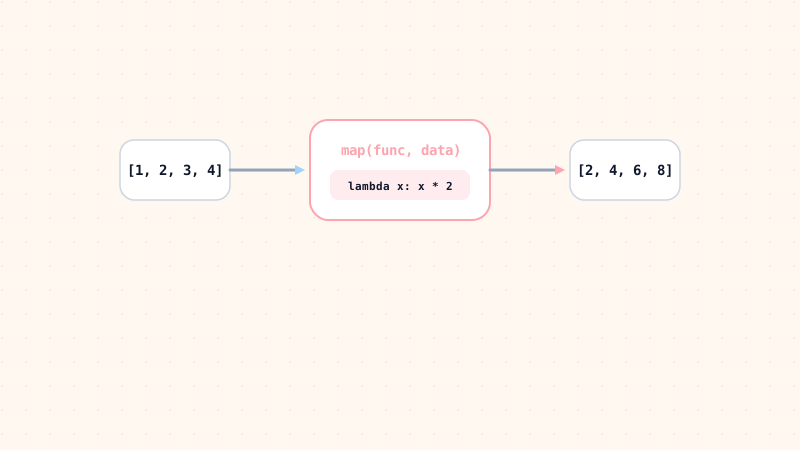
map(func, *iterables)
Applies a function to each item of an iterable lazily, returning an iterator:
nums = [1, 2, 3, 4, 5]
squares_iter = map(lambda x: x**2, nums)
print(list(squares_iter))  # [1, 4, 9, 16, 25]

# Mapping across multiple iterables in parallel (stops at shortest):
bases = [2, 3, 4]
exponents = [3, 2, 4]
powers = list(map(pow, bases, exponents))
print("Powers:", powers)  # [8, 9, 256]
filter(func, iterable)
Filters items where func(item) evaluates to truthy:
words = ["python", "deep", "dive", "ai", "architecture", "ml"]
long_words = list(filter(lambda w: len(w) > 3, words))
print("Long words:", long_words)  # ['python', 'deep', 'dive', 'architecture']
Modern Python Idiom: List & Generator Comprehensions
In modern Python, comprehensions are widely preferred over map and filter because they are faster (avoiding function call overhead) and more readable:
# map + filter combined via list comprehension
results = [x**2 for x in nums if x % 2 != 0]
print("Odd squares:", results)  # [1, 9, 25]
5. Reducing Iterables with functools.reduce
While map and filter produce sequences, a reducing function folds an entire sequence into a single cumulative value:
from functools import reduce

numbers = [1, 2, 3, 4, 5]

# Cumulative product (factorial of 5)
product = reduce(lambda acc, val: acc * val, numbers)
print("Product:", product)  # 120

# Finding maximum element via reduction
max_val = reduce(lambda a, b: a if a > b else b, [14, 82, 35, 99, 41])
print("Max value:", max_val)  # 99
6. Partial Functions with functools.partial
functools.partial allows developers to “freeze” certain arguments of a callable, creating a new callable with a reduced signature:
from functools import partial

def power(base, exponent):
    return base ** exponent

# Create specialized functions
square = partial(power, exponent=2)
cube = partial(power, exponent=3)

print("Square of 7:", square(7))  # 49
print("Cube of 4:", cube(4))      # 64
Practical Application: Reusable Numeric Converters
# Convert arbitrary binary strings to decimal integers
binary_to_int = partial(int, base=2)
hex_to_int = partial(int, base=16)

print(binary_to_int("10110"))  # 22
print(hex_to_int("1A3F"))      # 6719
7. High-Performance Functional Code with the operator Module
When using higher-order functions like sorted(), map(), or reduce(), developers often write small lambda expressions:
from functools import reduce
total = reduce(lambda a, b: a + b, [1, 2, 3, 4])
Every time Python invokes that lambda, it must construct a Python stack frame, perform bytecode dispatch, and resolve dynamic variable scopes.
The standard library’s operator module provides C-level implementations of all arithmetic, bitwise, and item-access operators:
import operator
from functools import reduce

# Fast, C-level reduction
total = reduce(operator.add, [1, 2, 3, 4])
factorial = reduce(operator.mul, range(1, 6))

print("Total:", total)          # 10
print("Factorial:", factorial)  # 120
operator.itemgetter and operator.attrgetter
Instead of lambda x: x['key'] or lambda x: x.attribute, use the optimized getters:
from operator import itemgetter, attrgetter

users = [
    {"username": "jdoe", "role": "admin", "login_count": 142},
    {"username": "asmith", "role": "editor", "login_count": 89},
    {"username": "bwayne", "role": "admin", "login_count": 310},
]

# Sort by login count descending (faster than lambda)
sorted_users = sorted(users, key=itemgetter("login_count"), reverse=True)
for u in sorted_users:
    print(f"User: {u['username']:10} Logins: {u['login_count']}")
Key Takeaways
- Callables: Any object implementing
__call__can be invoked with(). - Function Introspection: Functions store their signatures, docstrings, annotations, and defaults in attributes like
__code__,__defaults__, and__annotations__. - Lambdas: Useful for short, single-expression transforms and sorting keys.
- Partial Evaluation:
functools.partialsimplifies interfaces by pre-binding arguments. - Operator Module: Always prefer
operator.itemgetter,operator.attrgetter, andoperator.addover custom lambdas for critical performance paths.