
Functions are foundational to Python programming, but the mechanics of how Python handles parameters and binds incoming arguments involve subtle CPython internals that trip up even experienced engineers.
In this comprehensive article, based on Fred Baptiste’s Python Series series, we examine argument unpacking, positional-only and keyword-only constraints, and the internal representation of default parameter values in memory.
1. Parameters vs. Arguments
Before diving into syntax, let us establish strict terminology:
- Parameters (Formal Parameters): The identifiers declared in the function definition signature.
- Arguments (Actual Arguments): The values or object references passed into the function when invoked.
def calculate_tax(subtotal, tax_rate=0.08):  # subtotal, tax_rate are PARAMETERS
    return subtotal * (1 + tax_rate)

total = calculate_tax(100.0, 0.05)            # 100.0, 0.05 are ARGUMENTS
In Python, arguments are always passed by object reference (often referred to as call-by-sharing or call-by-assignment). The parameter name inside the function’s local scope becomes an additional pointer to the exact same object in the heap.
2. Positional and Keyword Arguments
When calling a function, arguments can be passed in two ways:
- Positional Arguments: Mapped to parameters strictly by their ordinal position from left to right.
- Keyword (Named) Arguments: Explicitly specified using
parameter_name=value.
def compute_volume(length, width, height):
    return length * width * height

# Positional
v1 = compute_volume(10, 5, 2)

# Keyword
v2 = compute_volume(height=2, length=10, width=5)

# Mixed: Positional arguments MUST precede keyword arguments
v3 = compute_volume(10, height=2, width=5)
If a positional argument appears after a keyword argument, Python raises a SyntaxError:
# SyntaxError: positional argument follows keyword argument
compute_volume(length=10, 5, 2)
3. Unpacking Arguments with * and **
Python provides powerful operators for packing and unpacking iterable and mapping structures into function arguments.
The * Iterable Unpacking Operator
The * operator unrolls any iterable (tuple, list, string, set, generator) into distinct positional arguments:
dimensions = [12, 6, 4]
volume = compute_volume(*dimensions)  # Equivalent to compute_volume(12, 6, 4)
print(f"Volume: {volume}")
Inside a function definition, *args collects an arbitrary number of excess positional arguments into an immutable tuple:
def compute_mean(*args):
    print("args type:", type(args), "value:", args)
    if not args:
        return 0.0
    return sum(args) / len(args)

print(compute_mean(10, 20, 30, 40))
# args type: <class 'tuple'> value: (10, 20, 30, 40)
# 25.0
The ** Dictionary Unpacking Operator
The ** operator unrolls a dictionary into keyword arguments where keys must be strings matching parameter names:
config = {"width": 8, "height": 3, "length": 15}
volume = compute_volume(**config)
print(f"Config Volume: {volume}")
Inside a function definition, **kwargs collects any unmatched keyword arguments into a standard dictionary:
def configure_engine(name, **kwargs):
    print(f"Engine: {name}")
    for key, val in kwargs.items():
        print(f"  {key} -> {val}")

configure_engine("V8-Biturbo", displacement=4.0, cylinders=8, boost_psi=18.5)
4. Keyword-Only and Positional-Only Parameters
Modern Python allows developers to strictly enforce how arguments must be supplied.
Keyword-Only Arguments (The Bare *)
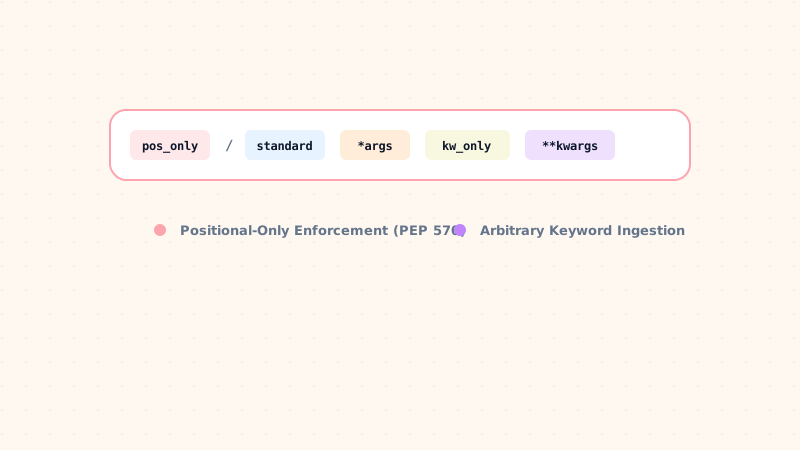
Any parameter declared after an asterisk (* or *args) cannot be passed positionally—it must be provided as a keyword argument:
def query_database(query, *, timeout=30, retry=True):
    print(f"Executing: {query} (timeout={timeout}, retry={retry})")

# Valid:
query_database("SELECT * FROM users", timeout=10, retry=False)

# TypeError: query_database() takes 1 positional argument but 3 were given
query_database("SELECT * FROM users", 10, False)
Using a bare * is an industry best practice for boolean flags or configuration options, making calls self-documenting.
Positional-Only Arguments (The Bare /)
Introduced in Python 3.8 (PEP 570), parameters defined before a forward slash (/) must be passed positionally:
def format_currency(amount, currency="USD", /, *, precision=2):
    return f"{amount:.{precision}f} {currency}"

# Valid:
print(format_currency(1250.5, "EUR", precision=2))

# TypeError: format_currency() got some positional-only arguments passed as keyword arguments: 'amount'
format_currency(amount=1250.5, currency="EUR")
5. The Infamous Mutable Default Parameter Trap
One of the most notorious gotchas in Python is assigning a mutable object (like a list or dictionary) as a default parameter value.
The Pitfall in Action
def append_log(message, log_entries=[]):
    log_entries.append(message)
    return log_entries

print(append_log("Server started"))
# ['Server started']

print(append_log("Database connected"))
# ['Server started', 'Database connected']  <-- UNEXPECTED ACCUMULATION!
Instead of a fresh empty list on every call, subsequent invocations mutate and share the exact same list!
Why Does This Happen? CPython Internals
In Python, def is an executable statement. When the Python compiler executes the def statement, it creates a function object in memory.
Default parameter values are evaluated once, at the exact moment the function is defined—not when the function is called!
Python attaches these default values directly to the function object in the __defaults__ tuple:
def append_log(message, log_entries=[]):
    log_entries.append(message)
    return log_entries

# Inspect the function object's internal defaults
print("Memory address of default list:", hex(id(append_log.__defaults__[0])))

append_log("Entry 1")
print("After call 1:", append_log.__defaults__)

append_log("Entry 2")
print("After call 2:", append_log.__defaults__)
Output:
Memory address of default list: 0x104b2a880
After call 1: (['Entry 1'],)
After call 2: (['Entry 1', 'Entry 2'],)
The identifier log_entries points directly to the memory address stored in append_log.__defaults__[0]. Because lists are mutable, calling .append() alters the shared object directly.
The Idiomatic Solution: Sentinel Value None
The universal Python pattern is to use None as the default value sentinel:
def append_log(message, log_entries=None):
    if log_entries is None:
        log_entries = []  # A brand-new list allocated on each invocation
    log_entries.append(message)
    return log_entries
Now, every time append_log executes without passing an explicit list, a brand-new list object is instantiated on the heap.
6. Function Parameter Introspection
Python functions store their parameter signatures in internal attributes:
func.__name__: The function name.func.__code__: The compiled code object (co_argcount,co_varnames,co_flags).func.__defaults__: Tuple of default values for positional/keyword parameters.func.__kwdefaults__: Dictionary of default values for keyword-only parameters.
We can inspect the complete signature programmatically with the inspect module:
import inspect

def process_pipeline(input_path, output_path, *, mode="fast", max_retries=3):
    pass

sig = inspect.signature(process_pipeline)
for param_name, param in sig.parameters.items():
    print(f"Parameter: {param_name:12} Kind: {param.kind.description:20} Default: {param.default}")
Output:
Parameter: input_path   Kind: positional or keyword Default: <class 'inspect._empty'>
Parameter: output_path  Kind: positional or keyword Default: <class 'inspect._empty'>
Parameter: mode         Kind: keyword-only         Default: fast
Parameter: max_retries  Kind: keyword-only         Default: 3
Key Takeaways
- Pass-by-assignment: Python passes pointers to objects on the heap. Rebinding a parameter name locally does not alter the caller’s reference; mutating an in-place mutable object does.
- Unpacking:
*unrolls iterables into positional arguments;**unrolls dictionaries into keyword arguments. - Keyword-Only Guard: Place
*before configuration flags to prevent errors caused by ambiguous positional arguments. - Default Evaluation Timing: Default arguments are bound once at function definition time in
__defaults__. Always useNonefor mutable defaults.