
Iteration is the lifeblood of idiomatic Python. Almost everything we interact with—lists, strings, files, database cursors, and network streams—relies on Python’s iteration architecture.
Yet many developers blur the boundaries between iterables, iterators, and generators. Understanding how Python traverses data under the hood unlocks the ability to stream massive datasets with a tiny, constant memory footprint ( RAM).
In this comprehensive article, based on Part 2 of Fred Baptiste’s Python Series, we dissect the mechanics of __iter__ and __next__, explore lazy evaluation with yield, master the itertools standard library, and build bidirectional coroutines.
1. The Iteration Hierarchy: Sequences vs Iterables vs Iterators
To understand Python iteration, we must understand the progression of protocols:
flowchart TD
    Seq["Sequence Protocol<br/>(__len__, __getitem__)"] --> Iterab["Iterable Protocol<br/>(__iter__ returns Iterator)"]
    Iterab --> Iterat["Iterator Protocol<br/>(__iter__ returns self, __next__)"]
    Iterat --> Gen["Generators & Yield<br/>(Stateful paused functions)"]
1. The Sequence Protocol
Before __iter__ was formalized, Python used the Sequence Protocol: if an object defines __getitem__ accepting integer indices 0, 1, 2... and raises IndexError at the boundary, Python’s for loop can iterate over it automatically.
class LegacySequence:
    def __init__(self, data):
        self._data = data

    def __len__(self):
        return len(self._data)

    def __getitem__(self, index):
        return self._data[index]

seq = LegacySequence(["alpha", "beta", "gamma"])
for item in seq:
    print(item)  # alpha, beta, gamma
2. The Iterable Protocol
An Iterable is an object that can produce an Iterator. It implements __iter__(), which instantiates and returns a new iterator every time it is called.
3. The Iterator Protocol
An Iterator is an object with state that tracks its position during traversal. It implements two methods:
__iter__(): Returnsself.__next__(): Returns the next element, or raisesStopIterationwhen traversal is finished.
class CountdownIterator:
    def __init__(self, start: int):
        self.current = start

    def __iter__(self):
        return self

    def __next__(self):
        if self.current <= 0:
            raise StopIteration
        val = self.current
        self.current -= 1
        return val

counter = CountdownIterator(3)
print(next(counter))  # 3
print(next(counter))  # 2
print(next(counter))  # 1
# print(next(counter)) raises StopIteration!
2. Demystifying the for Loop Under the Hood
When you write for item in collection:, Python performs the following bytecode translation:
# What you write:
# for item in collection:
#     process(item)

# What CPython actually executes:
iterator = iter(collection)  # Calls collection.__iter__() or uses fallback __getitem__
while True:
    try:
        item = next(iterator)  # Calls iterator.__next__()
    except StopIteration:
        break
    else:
        # Loop body
        print(f"Processing: {item}")
The Sentinel Form of iter()
A lesser-known CPython superpower is the two-argument form: iter(callable, sentinel). It invokes callable() repeatedly until the returned value equals sentinel:
import random

# Roll a die until we roll a 6
roll_die = lambda: random.randint(1, 6)

for roll in iter(roll_die, 6):
    print(f"Rolled {roll}")
print("Hit 6! Loop terminated.")
This pattern is widely used for chunked I/O streaming:
def read_binary_blocks(filepath, chunk_size=4096):
    with open(filepath, "rb") as f:
        # iter(lambda: f.read(chunk_size), b"") reads until empty bytes
        for block in iter(lambda: f.read(chunk_size), b""):
            process_block(block)
3. Generators and the Magic of yield
Writing custom classes with __iter__ and __next__ is verbose. Generators provide an elegant language-level syntax to define iterators using standard function syntax.
When a function contains the yield keyword, CPython flags it as a generator function (CO_GENERATOR flag). Calling it does not execute the function body; instead, it returns a generator object.
def count_up_to(max_val):
    print("-> Generator started")
    count = 1
    while count <= max_val:
        print(f"-> Before yielding {count}")
        yield count
        print(f"-> Resumed after yielding {count}")
        count += 1
    print("-> Generator finished")

gen = count_up_to(2)
print("Created generator object:", gen)

print(next(gen))
print("---")
print(next(gen))
print("---")
# next(gen) raises StopIteration
Execution Output:
Created generator object: <generator object count_up_to at 0x7f...>
-> Generator started
-> Before yielding 1
1
---
-> Resumed after yielding 1
-> Before yielding 2
2
---
-> Resumed after yielding 2
-> Generator finished
StopIteration
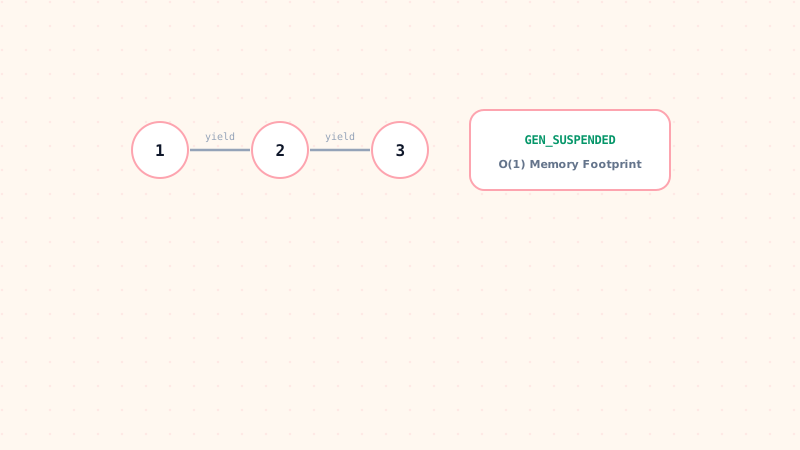
How CPython Suspends State
When a generator encounters yield:
- The evaluated expression is returned to the caller.
- The entire stack frame (local variables, instruction pointer, evaluation stack) is frozen in place inside a C heap structure (
PyGenObject). - Execution control is yielded back to the caller.
- When
next()is called again, CPython restores the exact CPU instruction pointer and local frame variables and continues execution.
4. Generator Expressions & Memory Efficiency
Compare a list comprehension with a generator expression:
import sys

# List comprehension: 10,000,000 integers materialized in memory
list_comp = [x ** 2 for x in range(10_000_000)]
print(f"List size in RAM : {sys.getsizeof(list_comp) / (1024 * 1024):.2f} MB")  # ~80 MB

# Generator expression: computed lazily on-demand
gen_exp = (x ** 2 for x in range(10_000_000))
print(f"Gen size in RAM  : {sys.getsizeof(gen_exp)} bytes")                     # ~104 bytes!
The generator expression takes roughly 104 bytes regardless of whether it processes 10 elements or 10 billion elements.
5. Streaming Pipelines: Processing Terabytes in RAM
Generators can be composed into declarative UNIX-like processing pipelines:
def read_log_lines(file_path):
    """Simulate streaming an infinite or multi-gigabyte log file."""
    for line in open(file_path, "r"):
        yield line.strip()

def filter_errors(lines):
    """Filter only lines containing ERROR."""
    for line in lines:
        if "ERROR" in line:
            yield line

def extract_ip(error_lines):
    """Extract IP address from log message."""
    for line in error_lines:
        parts = line.split()
        yield parts[0]

def count_unique_ips(ips):
    """Accumulate unique IPs without loading all raw lines into memory."""
    seen = set()
    for ip in ips:
        if ip not in seen:
            seen.add(ip)
            yield ip

# Composing the pipeline:
# lines -> filter_errors -> extract_ip -> count_unique_ips
# No records are held in memory simultaneously!
6. The itertools Standard Library Superpowers
Python’s built-in itertools module contains high-performance C-accelerated building blocks for iteration:
1. Slicing Infinite Streams: itertools.islice
Standard slicing [start:stop] does not work on generators because they do not implement __getitem__. islice solves this lazily:
import itertools

def fibonacci():
    a, b = 0, 1
    while True:
        yield a
        a, b = b, a + b

# Take the first 10 Fibonacci numbers from an infinite generator
first_ten = list(itertools.islice(fibonacci(), 10))
print("First 10 Fibonacci:", first_ten)
# [0, 1, 1, 2, 3, 5, 8, 13, 21, 34]
2. Chaining Multiple Iterables: itertools.chain
letters = ["a", "b", "c"]
numbers = [1, 2, 3]
symbols = ["!", "@", "#"]

combined = itertools.chain(letters, numbers, symbols)
print(list(combined))  # ['a', 'b', 'c', 1, 2, 3, '!', '@', '#']
3. Grouping Sorted Data: itertools.groupby
[!IMPORTANT]
groupbyonly groups consecutive duplicate keys. The input iterable must be sorted by the grouping key first!
transactions = [
    {"dept": "Engineering", "amount": 1200},
    {"dept": "Engineering", "amount": 800},
    {"dept": "HR", "amount": 400},
    {"dept": "Sales", "amount": 2500},
    {"dept": "Sales", "amount": 1500},
]

for dept, group in itertools.groupby(transactions, key=lambda x: x["dept"]):
    total = sum(item["amount"] for item in group)
    print(f"Department: {dept.ljust(12)} -> Total Expense: ${total}")
4. Splitting Iterators: itertools.tee
Duplicates an iterator into independent iterators:
data = [10, 20, 30, 40]
it1, it2 = itertools.tee(data, 2)

print(list(it1))  # [10, 20, 30, 40]
print(list(it2))  # [10, 20, 30, 40]
7. Coroutines: Bidirectional Communication with .send() and yield from
Generators are not just data producers; they can also be data consumers. When used this way, they are known as coroutines.
Sending Values into a Suspended Generator
Using val = yield, a generator receives data passed by the caller via generator.send(value):
def running_averager():
    total = 0.0
    count = 0
    average = None
    while True:
        # yield returns current average, and evaluates to the sent value!
        term = yield average
        if term is None:
            break
        total += term
        count += 1
        average = total / count

avg_coroutine = running_averager()

# Prime the coroutine by advancing to the first yield
next(avg_coroutine)  # returns None

print(avg_coroutine.send(10))  # 10.0
print(avg_coroutine.send(20))  # 15.0
print(avg_coroutine.send(30))  # 20.0
avg_coroutine.close()
Subgenerator Delegation: yield from
yield from <iterable> delegates control directly to another generator. It establishes a bidirectional pipeline where .send(), .throw(), and .close() pass straight through:
def sub_worker():
    received = []
    while True:
        val = yield
        if val == "DONE":
            break
        received.append(val)
    return f"Processed {len(received)} items: {received}"

def orchestrator():
    result = yield from sub_worker()
    print(f"Orchestrator received return value: {result}")

orch = orchestrator()
next(orch)  # Prime the sub_worker

orch.send("Packet 1")
orch.send("Packet 2")
try:
    orch.send("DONE")
except StopIteration:
    pass
# Output: Orchestrator received return value: Processed 2 items: ['Packet 1', 'Packet 2']
This bidirectional delegation mechanism was the exact architectural foundation that paved the way for modern async and await in Python.