
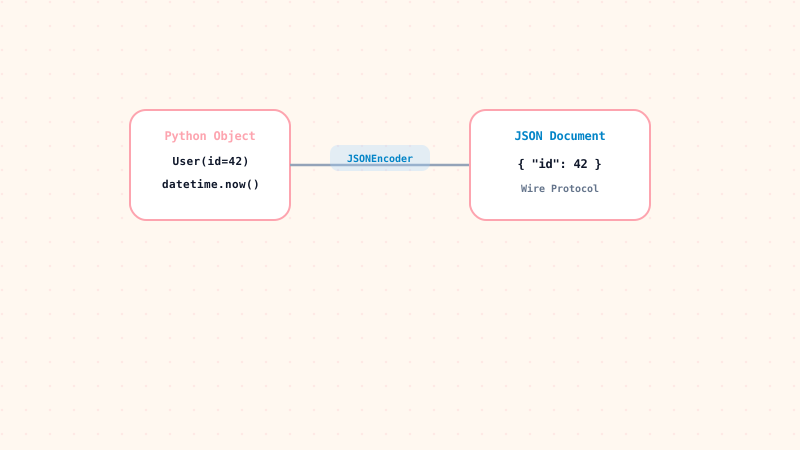
In distributed architectures, microservices, and web APIs, data must constantly traverse process boundaries. Serialization is the process of translating live in-memory Python objects into a persistent storage format or byte stream; deserialization reconstructs that state on the receiving end.
While serialization appears straightforward on the surface, real-world Python engineering quickly runs into hurdles: converting complex types (dates, decimals, UUIDs), intercepting data structures with custom encoders/decoders, and avoiding catastrophic security vulnerabilities in legacy binary protocols like pickle.
In this comprehensive article, based on Part 3 Section 09 of Fred Baptiste’s Python Series, we dissect Python serialization, audit pickle security vulnerabilities, construct custom json.JSONEncoder and object_hook decoders, and explore modern schema validation.
1. Serialization Fundamentals: The Standard Mappings
Python’s built-in json module provides four primary functions:
json.dumps(obj): Serializes Python objectobjto a JSON formattedstr.json.dump(obj, fp): Serializes Python objectobjas a JSON formatted stream to file-like objectfp.json.loads(s): Deserializes JSON stringsto a Python object.json.load(fp): Deserializes JSON formatted file-like objectfpto a Python object.
The Standard Conversion Table
The JSON specification only supports a small subset of primitive types:
| Python Type | JSON Equivalent |
|---|---|
dict | object ({}) |
list, tuple | array ([]) |
str | string ("") |
int, float | number |
True / False | true / false |
None | null |
Notice what is missing: datetime, date, Decimal, UUID, set, and custom class instances are NOT supported natively!
import json
from datetime import datetime
from decimal import Decimal

payload = {
    "account_id": 101,
    "balance": Decimal("1500.50"),
    "created_at": datetime.utcnow()
}

try:
    json.dumps(payload)
except TypeError as e:
    print("Serialization Error:", e)
    # Output: TypeError: Object of type Decimal is not JSON serializable
2. The Perils of pickle: Remote Code Execution (RCE)
Python’s standard library includes the pickle module, which can serialize almost any Python object—including functions, classes, and lambdas—into an opaque byte stream.
However, pickle is NOT secure against untrusted or unauthenticated data.
How an Attacker Exploits pickle.loads()
Python’s unpickler uses the __reduce__() protocol to determine how to reconstruct an object. An attacker can construct a payload that tells Python to call os.system with a malicious shell command:
import pickle
import os

class ExploitPayload:
    def __reduce__(self):
        # When unpickled, executes this arbitrary command!
        cmd = "echo 'CRITICAL: Arbitrary Code Executed via Pickle!' > /tmp/hacked.txt"
        return (os.system, (cmd,))

# Malicious payload packaged by attacker
malicious_bytes = pickle.dumps(ExploitPayload())

# Victim receives bytes from an untrusted network socket or cookie:
# The moment loads() is called, the shell command executes!
pickle.loads(malicious_bytes)
[!CAUTION] Never use
picklefor public APIs, cookies, caching untrusted requests, or cross-service communication. Reservepicklestrictly for short-lived internal IPC between trusted Python processes (such asmultiprocessing).
3. Custom JSON Encoders
To serialize rich domain objects cleanly without crashing, we have two approaches:
Approach A: The default Function
The default argument in json.dumps() specifies a fallback function invoked whenever Python encounters an object it cannot serialize:
import json
from datetime import datetime, date
from decimal import Decimal
from uuid import UUID

def custom_serializer(obj):
    if isinstance(obj, (datetime, date)):
        return obj.isoformat()
    if isinstance(obj, Decimal):
        return float(obj)  # Or str(obj) to preserve exact precision
    if isinstance(obj, UUID):
        return str(obj)
    if isinstance(obj, set):
        return list(obj)
    raise TypeError(f"Object of type {type(obj).__name__} is not JSON serializable")

data = {
    "timestamp": datetime(2026, 1, 2, 12, 0, 0),
    "amount": Decimal("299.99"),
    "tags": {"python", "serialization"}
}

json_str = json.dumps(data, default=custom_serializer, indent=2)
print(json_str)
Approach B: Subclassing json.JSONEncoder
For complex enterprise codebases, encapsulate your serialization rules in a custom class:
class EnhancedJSONEncoder(json.JSONEncoder):
    def default(self, obj):
        if isinstance(obj, (datetime, date)):
            return obj.isoformat()
        if isinstance(obj, Decimal):
            return str(obj)
        if hasattr(obj, "__json__"):
            # Allow custom domain classes to define their own __json__ method!
            return obj.__json__()
        return super().default(obj)

class UserProfile:
    def __init__(self, user_id: int, username: str, joined: datetime):
        self.user_id = user_id
        self.username = username
        self.joined = joined

    def __json__(self):
        return {
            "id": self.user_id,
            "username": self.username,
            "joined_at": self.joined.isoformat()
        }

user = UserProfile(42, "alex", datetime(2025, 6, 15))
print(json.dumps(user, cls=EnhancedJSONEncoder, indent=2))
4. Custom JSON Decoders: object_hook
When reading JSON back into Python, strings are just strings. But what if you want ISO timestamp strings automatically parsed back into real Python datetime objects?
The object_hook parameter receives every decoded dictionary before it is returned:
import json
from datetime import datetime

raw_json = '''
{
  "event_id": "EVT-9021",
  "created_at": "2026-01-02T14:30:00",
  "actor": "admin"
}
'''

def datetime_parser(dct: dict) -> dict:
    for key, value in dct.items():
        if isinstance(value, str):
            # Attempt to parse ISO dates
            try:
                dct[key] = datetime.fromisoformat(value)
            except (ValueError, TypeError):
                pass
    return dct

decoded = json.loads(raw_json, object_hook=datetime_parser)

print("Decoded type of created_at:", type(decoded["created_at"]))
# Output: <class 'datetime.datetime'>
print("Year:", decoded["created_at"].year)  # 2026
Preserving Decimal Precision with parse_float
Standard JSON parses numbers with decimals into IEEE-754 binary floats (float), introducing precision errors in financial figures (0.1 + 0.2 != 0.3). You can force CPython to parse numbers directly into Decimal:
from decimal import Decimal

financial_json = '{"price": 19.99, "tax": 1.60}'

# Decode floats directly into Decimal objects
parsed = json.loads(financial_json, parse_float=Decimal)

print(type(parsed["price"]))  # <class 'decimal.Decimal'>
print(parsed["price"] + parsed["tax"])  # Decimal('21.59') (Exact!)
5. Modern Declarative Serialization: Pydantic v2
In modern Python services (FastAPI, LangChain, modern data pipelines), manual encoder writing is largely superseded by Pydantic:
from pydantic import BaseModel, Field
from datetime import datetime
from decimal import Decimal
from uuid import UUID, uuid4

class OrderModel(BaseModel):
    order_id: UUID = Field(default_factory=uuid4)
    item_name: str
    amount: Decimal
    ordered_at: datetime = Field(default_factory=datetime.utcnow)

# Instant bidirectional validation & serialization
order = OrderModel(item_name="Mechanical Keyboard", amount=Decimal("149.50"))

# Fast C/Rust serialization to JSON string
json_output = order.model_dump_json(indent=2)
print("Pydantic JSON:\n", json_output)

# Deserialization with strict schema validation
restored_order = OrderModel.model_validate_json(json_output)
print("Restored order ID:", restored_order.order_id)
Serialization Engine Benchmark Comparison
For ultra-high-throughput APIs parsing gigabytes of JSON per second:
json(CPython Standard Library): Baseline speedujson(UltraJSON): ~2x-3x fasterorjson(Rust-accelerated): ~10x to 15x faster with native support fordataclasses,numpyarrays, anddatetimeobjects.