
Every non-trivial Python project is composed of modules and packages. Yet many developers view the import statement as a black box—until confronted with a cryptic ImportError: cannot import name ... (most likely due to a circular import) or unexpected namespace collisions.
In Python, modules are not merely file paths; they are first-class objects (types.ModuleType) living in memory, cached in a global interpreter dictionary, and powered by an extensible finder/loader subsystem.
In this comprehensive article, based on Part 1 Section 09 of Fred Baptiste’s Python Series, we dissect Python’s import machinery, trace module caching in sys.modules, master package resolution, resolve circular imports cleanly, and harness PEP 420 namespace packages.
1. What is a Module in Python?
A Python module is simply a singleton instance of the built-in type types.ModuleType:
import math
import types

print(type(math))  # <class 'module'>
print(isinstance(math, types.ModuleType))  # True
print(f"Module name: {math.__name__}")     # "math"
print(f"Module file: {getattr(math, '__file__', 'built-in')}")
Every module possesses its own namespace dictionary (__dict__). When code executes inside a module, the globals() function actually returns that module’s __dict__!
# A module is just a dictionary wrapper with attributes
print("pi" in math.__dict__)  # True
print(math.__dict__["pi"])    # 3.141592653589793
2. The Import Machinery: How CPython Resolves Imports
When you write import my_module or from my_module import calculate, Python performs the following step-by-step lifecycle:
flowchart TD
    Start["import my_module"] --> Cache{"Is 'my_module' in<br/>sys.modules?"}
    Cache -- Yes --> ReturnMod["Return cached module from sys.modules"]
    Cache -- No --> FindSpec["Search sys.meta_path finders for ModuleSpec"]
    FindSpec --> SpecFound{"Spec Found?"}
    SpecFound -- No --> Err["Raise ModuleNotFoundError"]
    SpecFound -- Yes --> CreateMod["Loader creates types.ModuleType<br/>and inserts into sys.modules"]
    CreateMod --> ExecBytecode["Loader executes module bytecode<br/>populating module.__dict__"]
    ExecBytecode --> BindVar["Bind symbol to caller namespace"]
Step 1: Cache Inspection (sys.modules)
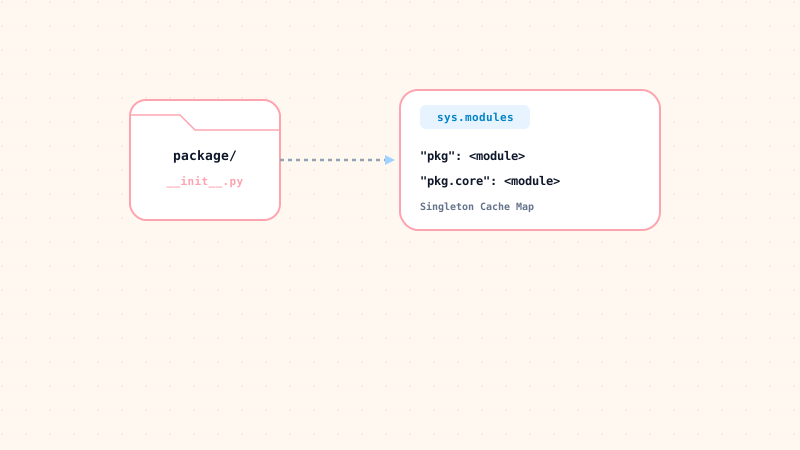
Python inspects sys.modules, a standard Python dictionary mapping module names (strings) to module objects:
import sys

# If it is already in sys.modules, NO file I/O or compilation occurs!
print("sys" in sys.modules)    # True
print("math" in sys.modules)   # True
Step 2: Finding the Module Specification (sys.meta_path)
If the module is not cached, Python iterates through a list of meta path finders in sys.meta_path:
BuiltinImporter: Finds C-level built-in modules likesys.FrozenImporter: Finds frozen bytecode compiled into the Python binary.PathFinder: Searches directories insys.pathfor.py,.pyc, and C-extensions (.so/.pyd).
Step 3: Module Instantiation and Bytecode Execution
Once the finder produces a ModuleSpec, the loader:
- Allocates an empty
types.ModuleType(spec.name). - Immediately registers this empty module into
sys.modules(before running its code!). - Compiles the file’s Python code into bytecode (if no fresh
.pycexists). - Executes the bytecode in the module’s
__dict__. - Binds the module name into the importing file’s local scope.
3. Packages vs. Modules: __init__.py and __path__
A module is a single file containing Python code (math.py).
A package is a module that can contain sub-modules and sub-packages. What makes a module a package is the presence of a __path__ attribute:
import os
import urllib
import urllib.request

print(hasattr(os, "__path__"))      # False (standard single-file module)
print(hasattr(urllib, "__path__"))  # True (it is a package!)
print(urllib.__path__)              # List of filesystem directories
The Role of __init__.py
When a regular package is imported (import mypkg), Python locates the directory containing __init__.py and executes __init__.py.
__init__.py serves three main roles:
- Package Initialization: Executing setup code, initializing loggers, or configuring defaults.
- API Facade / Export Cleanliness: Re-exporting nested classes so users write
from mypkg import Clientinstead offrom mypkg.network.http.client import Client. - Controlling Wildcard Imports: Defining the
__all__list.
# mypkg/__init__.py
from .network import Client
from .utils import format_payload

# Explicitly declare public exports for 'from mypkg import *'
__all__ = ["Client", "format_payload"]
4. PEP 420: Implicit Namespace Packages
Since Python 3.3 (PEP 420), a directory does not require an __init__.py to be importable! Directories without __init__.py are recognized as Namespace Packages.
/company/
  ├── auth_service/
  │   └── acme/
  │       └── auth/
  │           └── login.py
  └── billing_service/
      └── acme/
          └── billing/
              └── invoice.py
Notice there is NO __init__.py inside either acme/ directory. When both services are added to sys.path:
# Both components merge seamlessly under the shared 'acme' namespace!
from acme.auth import login
from acme.billing import invoice

import acme
print(acme.__path__)
# _NamespacePath(['/company/auth_service/acme', '/company/billing_service/acme'])
This pattern is widely used in large enterprises and microservices to split one logical package (google.cloud.*, azure.*, acme.*) across completely independent Git repositories and Python packages.
5. Relative vs. Absolute Imports
Python supports two import styles:
1. Absolute Imports (Recommended)
Specifies the full path from the project root:
# Fully qualified and unambiguous
from myapp.services.auth import AuthService
from myapp.database.connection import get_db
2. Relative Imports
Uses leading dots . to navigate relative to the current module’s position:
from . import config(same directory)from .models import User(sibling module)from ..database import get_db(parent directory)
[!WARNING] Relative imports rely strictly on the module’s
__name__attribute (e.g.,myapp.services.auth). If you attempt to run a file containing relative imports directly withpython myapp/services/auth.py,__name__becomes"__main__", and Python raises:ImportError: attempted relative import with no known parent package. Always run your application using the module flag:python -m myapp.services.auth.
6. The Circular Import Trap and How to Fix It
A circular import occurs when Module A imports Module B, and Module B imports Module A:
flowchart LR
    ModA["module_a.py<br/>from module_b import func_b<br/>def func_a(): ..."] -->|"imports"| ModB["module_b.py<br/>from module_a import func_a<br/>def func_b(): ..."]
    ModB -->|"imports"| ModA
Why Does It Crash?
Trace the execution:
- Python starts executing
module_a.py. - It encounters
from module_b import func_b. Python halts execution ofmodule_aand jumps to loadmodule_b. module_b.pystarts executing. It reachesfrom module_a import func_a.- Python checks
sys.modules.module_ais already insys.modules! - Python attempts to read
func_afrommodule_a.__dict__. - Crash!
func_ahas NOT been defined yet becausemodule_apaused at line 1! - Python raises:
ImportError: cannot import name 'func_a' from partially initialized module 'module_a'.
Three Ways to Fix Circular Imports:
Solution 1: Refactor Shared Logic (Cleanest)
Extract the shared classes, interfaces, or functions into a new module (e.g., models.py or common.py) that both modules depend on.
Solution 2: Import the Module, Not the Symbol
Instead of importing the function directly, import the module namespace:
# module_a.py
import module_b

def func_a():
    return module_b.func_b()  # Resolved at call time, not import time!
Solution 3: Defer the Import Inside the Function
# module_a.py
def process():
    # Only imported when process() is called, well after all modules have initialized!
    from module_b import func_b
    return func_b()
7. Dynamic Imports with importlib and __main__.py
Dynamic Loading with importlib
When building plugins or configurable drivers:
import importlib

def load_plugin(plugin_path: str):
    # plugin_path = "plugins.analytics.MixpanelLogger"
    module_name, class_name = plugin_path.rsplit(".", 1)

    # Dynamically import the module
    mod = importlib.import_module(module_name)

    # Retrieve class object from module namespace
    cls = getattr(mod, class_name)
    return cls()
Executable Packages with __main__.py
If you place a __main__.py file at the root of a package:
my_cli/
  ├── __init__.py
  ├── __main__.py
  └── core.py
Users can invoke your package directly from the command line:
python -m my_cli --port 8080CPython recognizes the -m flag, imports the package, and executes __main__.py as the entry point script.