Introduction to Machine Learning
Definition :
Machine Learning is a subset of Artificial Intelligence that focuses on the development of algorithms that allows computers to learn from and make predictions or decisions based on data.
Key Idea :
Instead of explicitly programming rules (as in expert systems), ML algorithms identify patterns in data and improve performance over time.
In short, Machine Learning is similar to a mathematical function, it takes input data, predicts an output and provides a response.
Types of Machine Learning :
- Supervised Learning : The model is trained on a labeled dataset where the desired output is known.
- Unsupervised Learning : The model works on an unlabeled dataset, trying to identify hidden patterns.
- Reinforcement Learning : The model learns by interacting with an environment and receiving awards and penalties
How does Machine Learning works?
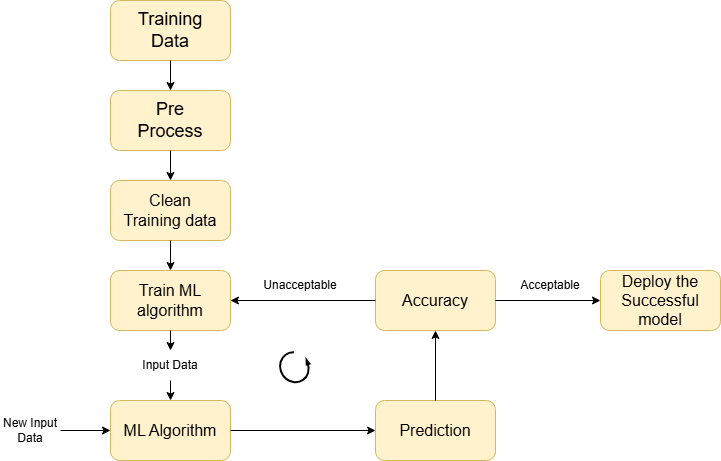
fig. 1 : Steps involved in Machine Learning
What are different Machine Learning Problems?
-
Regression : Predict Continuous values e.g. predict stock prices. These regression problems can be further divided into
– Simple Linear Regression
– Multiple Linear Regression
– Non Linear Regression
-
Classification : Classify the data points based on the features of the classes in the data points. Some classifications techniques are.
– KNN
– Naive Bayes
– Logistic Regression
-
Clustering : Partitioning the data into clusters based on feature similarity.
– K-Means clustering
– Hierarchical clustering
Calculus : Helps in optimizing algorithms by finding maximum and minimum points (e.g. cost function optimization in gradient descent, backpropagation in Neural Networks).
Probability and Statistics : Machine Learning often makes predictions under uncertainty and probability theory provides the mathematical formula (Algorithms like Naive Bayes, Bayesian Network, Markov Decision Process).
Linear Algebra : Data is often represented as matrices or vectors (e.g. dot product, matrix multiplication, eigen values, eigen vectors are fundamentals in algorithms like PCA).
Reference Books :
-
Pattern Recognition and Machine Learning
Book by Christopher Bishop
-
Understanding Machine Learning: From Theory to Algorithms
Textbook by Shai Ben-David and Shai Shalev-Shwartz
-
Deep Learning
Textbook by Aaron Courville, Ian Goodfellow, and Yoshua Bengio
-
Hands-On Machine Learning with Scikit-Learn and TensorFlow: Concepts, Tools, and Techniques to Build Intelligent Systems
Book by Aurelien Geron